
Centre for Teaching Excellence
Develop My Teaching | Indigenization & DecolonizationThis header photo shows part of Skw’cháys’ 2021 awakening ceremony
Indigenization & Decolonization
Indigenization and Decolonization
Welcome, thank you for visiting. Here you will find invitations to (re)consider, (re)examine, and (re)imagine with Indigenization, decolonization, teaching, and learning. These offerings are not prescriptive or definitive, but invite you to think and practice attentively.
Indigenizing
Indigenizing might mean something different depending on the person, context, protocol, place, or something else entirely. The description we offer at the CTE is an active process of centring Indigenous ways of knowing, thinking, and learning.
“Indigenizing the curriculum is positioned as a verb, not a noun, not an outcome… the process of indigenizing means that we are engaged in exploring what Indigenous knowledge is, how might we understand the nature of Indigenous knowledge.”(Archibald, 2012)
As a place to start, consider exploring the resources offered in But first: Places you might wander.
Decolonizing
To describe decolonization with finality is an impossible task. Perhaps decolonization could be thought of as the process of challenging, resisting, reimaging, and/or transforming an academic system that is accountable to Indigenous peoples, lands, waters, and knowledges. Perhaps decolonization considers systemic, structural, historical, and present mechanisms of (dis)advantage. Perhaps decolonization exists in how you introduce yourself, host a class, invite multitudes of knowing, write a learning objective, or assign course readings.
“Decolonization brings about the repatriation of Indigenous land and life; it is not a metaphor for other things we want to do to improve our societies and schools. The easy adoption of decolonizing discourse by educational advocacy and scholarship, evidenced by the increasing number of calls to “decolonize our schools,” or use “decolonizing methods,” or, “decolonize student thinking”, turns decolonization into a metaphor.” (Tuck & Yang, 2012)
As a place to start, consider exploring the resources offered in But first: Places you might wander.
But first, a gift: Places you might wander
Wherever you are on your journey, we want to offer you a gift first. Carefully plucked and placed on the plate are a few invitations to closely consider Indigenization, decolonization, teaching, and learning. We have selected only a few of the multitude of resources; the places you go next are up to you.

Podcast: Looking Back to Potlatch
In the sixth episode of Walking in Relation Podcast, Justin Wilson and Aaron Nelson Moody discuss “(re)learning to be human, the long road of decolonizing institutions and their seminal article: Looking Back to the Potlatch as a Guide to Truth, Reconciliation, and Transformative Learning.”
This podcast series was created by Carolyn Roberts and Calder Cheverie. It offers a glimpse into the contemporary challenges and successes of decolonial change within places of learning—from elementary to post-secondary—and the Indigenous leaders ushering in this change. It features conversations with the Indigenous voices reshaping and reimagining education.

Article: Beyond Riel: Bringing Métis Content into the Classroom
In this article Métis scholar Laura Forsythe (2025) discusses underrepresentation of Métis perspectives within the Canadian Education system, and the nuances of incorporating Métis ways of knowing. Lessons from the development and implementation of a Métis-focused post-baccalaureate course as well as pragmatic approaches to implementing Métis content in a good way are discussed.
Image adapted from Forsythe (2025) titled Métis Memories of Residential Schools: A Testament to the Strength of the Métis (Art Inspired by Samantha Pratt)

Book: Re-Storying Education: Decolonizing Your Practice Using a Critical Lens
“Re-Storying Education is a process of dismantling old narratives taught in education and rebuilding new narratives that include all the voices that have created this place known as Canada today…
“Drawing from her own experiences as an Indigenous student, educator, and administrator, in public and band-operated school systems, Indigenous academic Carolyn Roberts offers a deep understanding of how to support educators with Indigenous education and to create a nurturing and inclusive environment for all students. Re-Storying Education brings wider perspectives, connections to the land and the people of this land, and a deeper understanding of how relationships to these can change the educational experience for all students.” -provided by the publisher

Film: Faculty Perspectives, What I Learned in Class Today
As part of the larger What I Learned in Class Today ecosystem, this two-part film focuses on interviews with Indigenous and non-Indigenous faculty at the UBC Vancouver campus. Across the films, key themes from faculty perspectives include positionality, Indigenous student support, tending to the affective side of the classroom, knowledge gaps and Indigenous tokenization, classroom interventions, and broad accountability in continuing this work.
This film was created by the Indigenous Initiatives Team, at UBC’s Centre for Teaching, Learning, and Technology. Their website also includes a student perspective film, thematic articles, discussion questions, and a facilitation guide.

Video: Indigenization and Decolonization of Education
In this video, Carleen Thomas shares about Indigenization, decolonization, and education. Carleen Thomas (Tsleil-Waututh Nation) is a 2025-2026 Elder-in-residence at CapU, chancellor at Emily Carr University of Art and Design, as well as special projects manager at TsleilWaututh!, educator, and former Tsleil-Waututh Nation council member.

Book: Tiná7 Cht Ti Temíxw (We come from this Land)
“From the watersheds of the Squamish and Mamquam Rivers and Howe Sound in the north to English Bay, False Creek, and Burrard Inlet in the south, Sḵwx̱wú7meshulh Aysá̓ych (Squamish Territory) encompasses saltwater and rushing rivers, old-growth forests at valley bottoms, and alpine meadows high above the ocean. Tiná7 Cht Ti Temíxw—We Come From This Land is a powerful introduction to the vast history of the Sḵwx̱wú7mesh people. Drawing on stories from our Elders and in-depth research, we trace our history and culture from ancient times to the present day, offering a launching point for discovering more about the places, people, and stories found here.”–Page 4 of cover
Website: First Peoples Principles of Learning
Jo Chrona (2016) describes this website as “created to help educators in British Columbia understand how they might incorporate the First Peoples Principles of Learning (FPPL) into their classrooms and schools. Some educators will see that the Principles reflect what they already believe, and are doing in their schools and classrooms. Other educators will see concepts embedded in the principles that challenge some of the post-industrial Euro-centric beliefs about education. Either way, this site is not intended to be a comprehensive exploration of First Peoples (or Indigenous) education. It is instead, a beginning (or continuation) of a conversation.”
To view the FPPL as shared by the First Nations Education Steering Committee visit: https://www.fnesc.ca/first-peoples-principles-of-learning/
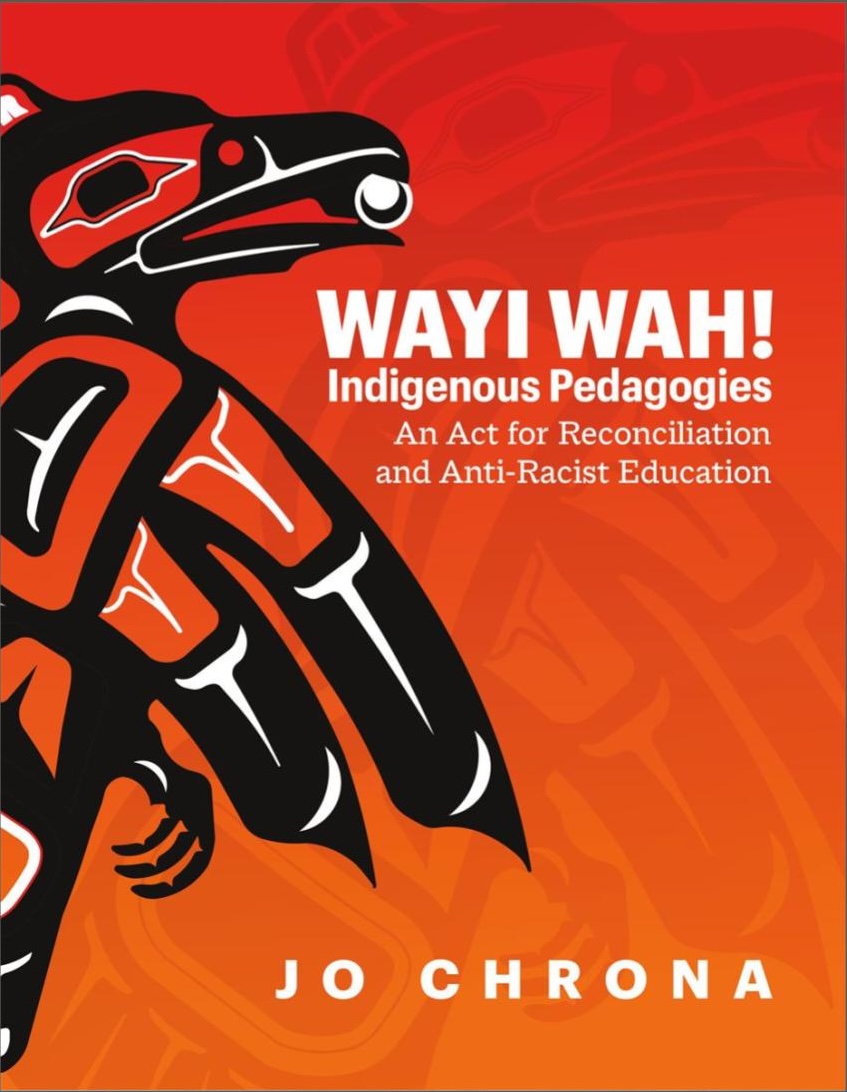
Book: Wayi Wah! Indigenous Pedagogies An Act for Reconciliation and Anti-Racist Education
“How can Indigenous knowledge systems inform our teaching practices and enhance education? How do we create an education system that embodies an anti-racist approach and equity for all learners? This powerful and engaging resource is for non-Indigenous educators who want to learn more, are new to these conversations, or want to deepen their learning.” -provided by publisher
Capilano University Library Resources
Capilano University Librarians have developed a number of guides and resources to help you work towards indigenizing the curriculum in your course.
Introduction – Indigenous Resources – Guides at Capilano University
Indigenous Resource Guides, Territorial Acknowledgement and Situating Self at Capilano University
For more information on these resources, contact library@capilanou.ca.
Paddling Together: Capilano University’s Living Document
The name Chén̓chenstway comes from the Squamish language. It means to support and respect each other and to work together with a light heart that lifts everyone up to get the work done.
– Elder Latash Nahanee
Chén̓chenstway is a living document that outlines Capilano University’s journey of reconciliACTION and learning. This document guides the University in supporting Indigenous ways of knowing and strengthening its relationship with Host Nations and Métis.

Looking for support?
Contact Christina Lennox, Educational Developer– Indigenous Pedagogies, with questions or to schedule a time to meet.
Capilano University respectfully acknowledges that our campuses are located on the unceded territories of the səlilwətaɬ (Tsleil-Waututh), Sḵwxwú7mesh (Squamish) and xʷməθkʷəỷəm (Musqueam) Nations.
Center for Teaching Excellence | Birch Building 2nd floor, BR238
Capilano University | 2055 Purcell Way | North Vancouver | BC | Canada | V5J 3H5